You’re dividing up a floor, maybe an office, maybe a home, and two contractors give you two completely different recommendations. One says brick, because “that’s how it’s always done.” The other says drywall, because it’s faster and cheaper. Neither explains why, and you’re left picking a wall type based on whoever sounded more confident.
That’s the wrong way to decide. Drywall partition vs brick wall isn’t a question with one universal winner. It depends on what the wall needs to do, how fast you need it done, and what you’re willing to spend. As one of the best interior designer team working across Karachi’s homes and offices, here’s what we tell clients when they ask us this exact question.
What Is the Difference Between Drywall and a Brick Wall?
A brick wall is built traditionally: bricks, cement, mortar, and plaster, laid course by course and left to cure. It’s solid, heavy, and part of the building’s physical mass.
A drywall partition works differently. It’s built on metal stud framing, a lightweight steel skeleton, with gypsum board or fibre cement board screwed onto either side. There’s no wet work involved beyond the joint filling and finishing, which is one reason it goes up so much faster.
This is the core of the difference between drywall and brick wall: one adds physical mass to a structure; the other creates a lightweight structure that divides space without adding significant weight.
Drywall Partition vs Brick Wall: Quick Comparison
| Factor | Drywall Partition | Brick Wall |
| Wall thickness | 3.75 to 5 inches (with framing) | 4.5 to 9 inches depending on type |
| Installation time | 2 to 4 days for a standard room | 1 to 2 weeks, including curing time |
| Structural load onthe building | Minimal, non-load-bearing | Adds real weight, may need structural review |
| Fire resistance | Good, with fire-rated gypsum board or fibre cement board | Naturally good, non-combustible |
| Moisture resistance | Requires moisture-resistant gypsum for moist areas or fibre cement board for wet areas | Naturally more tolerant to humidity |
| Sound insulation | Good with proper insulation infill | Good due to mass, but depends on plaster finish |
| Thermal insulation | Better, especially with an insulated cavity | Weaker unless combined with insulation |
| Demolition and reusability | Easy to remove, minimal debris | Labour-intensive, generates heavy debris |
| Cost per sq ft | Generally higher | Generally lower |
The table gives you the shape of it, but a few of these points need more context before you decide.
Drywall vs Brick Wall Cost Comparison
Cost is usually the first question, and it’s also where people get surprised. A drywall vs brick wall cost comparison isn’t just about material price. Labour, curing time, and finishing work all factor in.
Drywall partition price in Karachi typically runs between Rs. 550 and Rs. 1,000 per sq ft, depending on board type, framing specification, and finish. There’s no masonry labour, no curing period, and less finishing work involved. The framing goes up, the boards go on, joints get taped and filled, and the wall is ready for paint within days.
Brick wall construction cost typically runs between Rs. 250 and Rs. 400 per sq ft, and it’s higher partly because of the material and labour itself, but also because of everything that comes with it: foundation load consideration, plaster work, curing time before the wall can be painted, and higher disposal cost if the wall ever needs to come down. Both figures are market estimates and will shift based on site conditions, so it’s worth getting them confirmed against your actual layout.
If you’re partitioning a rented commercial floor or a home that might be reconfigured later, that cost gap matters twice: once when you build it, and again if you ever need to remove it. The same logic applies to other build-outs in the same project; our false ceiling price guide breaks down costs the same way if you’re budgeting for the ceiling alongside the walls.
Which Is Better: Drywall or Brick Wall?
The honest answer is that which is better, drywall or brick wall, depends entirely on what the wall is for.
For a non-load-bearing partition, drywall is usually the better fit. It’s quick, clean, and easy to reconfigure if your layout changes down the line, which matters a lot for offices that grow or restructure teams.
For a load-bearing wall, brick is the only real option. This is the core distinction between a load-bearing wall and a non-load-bearing wall: brick can carry structural weight; drywall cannot. If a wall is holding up part of the building, drywall was never a candidate to begin with.
For high-moisture areas like bathrooms or kitchens, brick has a natural edge because it tolerates humidity without extra treatment. Drywall can still work here, but it needs moisture-resistant gypsum board or fibre cement board, and even then, it’s not the first choice for constant water exposure.
For renovation projects, drywall tends to win on practicality. A renovation that involves reconfiguring rooms benefits from a wall type you can remove and rebuild without tearing into the building’s structure or generating a mountain of debris.
Partition Wall for Office and Home: What Changes
A partition wall for office and home doesn’t always need the same specification, even though the underlying material choice is similar.
In an office, office partition walls usually need to balance speed, sound insulation between meeting rooms, and the flexibility to move walls if the floor plan changes with headcount. Drywall handles all three well, especially with acoustic infill in the cavity for meeting rooms and cabins.
In a home, the priority often shifts toward permanence and finish. A fibre cement board or gypsum partition wall works fine for a home office or a bedroom division, but bathrooms, kitchens, and boundary walls still lean toward brick or block construction for durability and moisture handling.
Gypsum Board Partition in Pakistan: Where It Fits
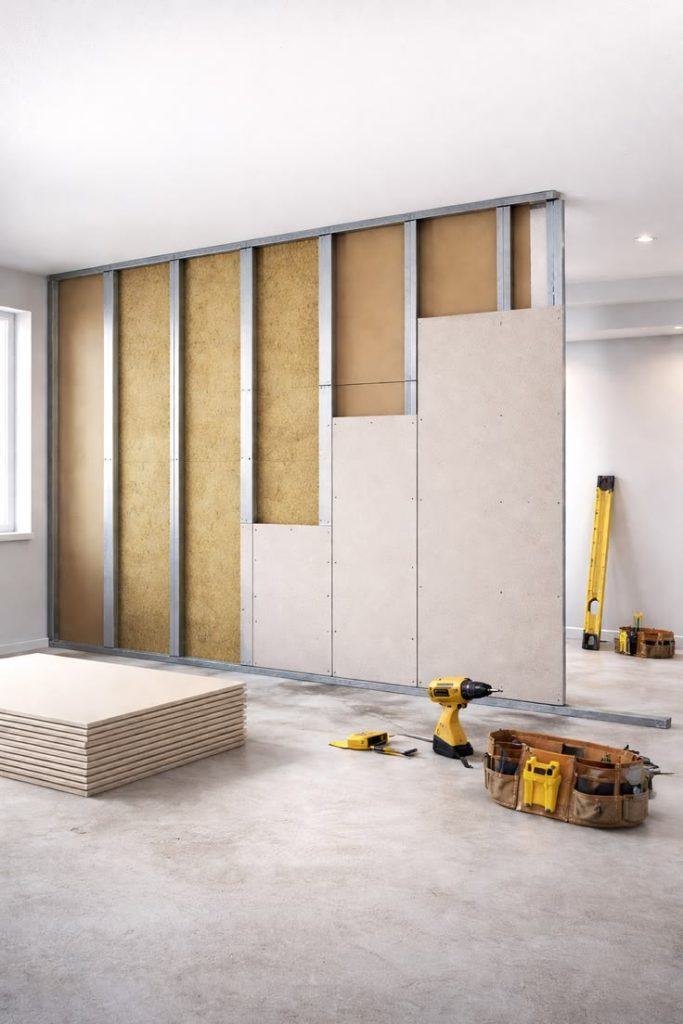
Gypsum board partition in Pakistan has become common in commercial fit-outs for a simple reason: most office interiors don’t need load-bearing walls; they need fast, clean division of space. Karachi’s commercial real estate market, where tenants frequently renegotiate leases and reconfigure floors, rewards a wall system that can go up and come down without major cost or mess.
That’s also where drywall earns its practical edge. If you need to add a cabin, remove a meeting room, or reshape a floor plan two years into a lease, a drywall partition gets you there in days, not weeks, and without the structural implications of brick.
None of this means brick is outdated. It’s simply suited to a different job: exterior walls, load-bearing structures, and areas where permanence matters more than speed.
Fibre Cement Board Partition in Pakistan: Where It Fits
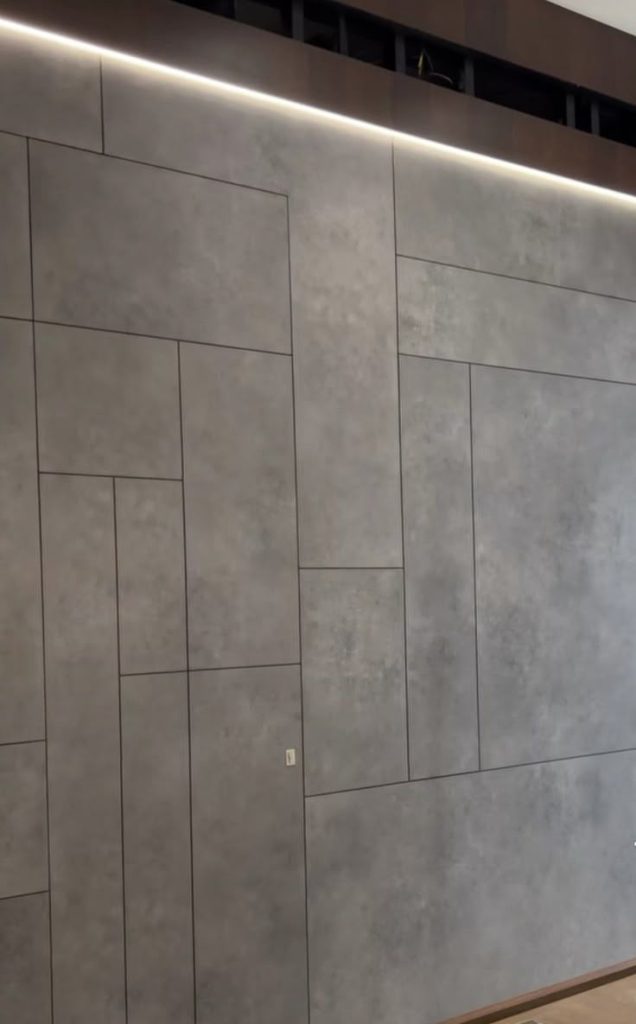
Fibre cement board is the sturdier cousin of gypsum board. It’s denser, holds up better against moisture, and doesn’t soften or sag the way gypsum can in humid conditions, which makes it a better fit for Karachi’s climate in spaces like washrooms, pantries, and any partition near a wet zone. It costs more than standard gypsum board, but still comes in well under brick once you factor in installation time and labour.
In practice, most projects don’t need fibre cement board across the entire floor. It makes the most sense for partitions that back onto bathrooms or kitchens, or in commercial spaces like schools and hospitals where durability and moisture resistance matter more than in a typical office partition. For everything else, gypsum board partition remains the most cost-effective choice.
Making the Right Call for Your Space
If you’re still weighing drywall against brick for your project, the decision usually comes down to four questions: does the wall need to bear a load, does it fit in your timeline, does it fit in your budget, and how likely are you to change the layout later? Answer those honestly, and the right material tends to become obvious.
If your space calls for a bot, division walls in drywall, and a feature wall in textured finish, we handle that combination often. Our drywall partition service covers office and home partitioning end-to-end, and if you’re finishing the space further, our wall paneling service pairs well with either wall type for a more defined look. If the project includes ceiling work too, our false ceiling service page covers that side of the fit-out.
Get in touch for a site visit, and we’ll tell you honestly whether drywall, brick, or a mix of both makes sense for your layout and budget.
FAQs
Is a drywall partition strong enough for offices?
Yes, for non-load-bearing division of office space. Drywall with proper metal stud framing holds up well for cabins, meeting rooms, and general partitioning, though it’s not meant to carry structural load.
How long does drywall partition installation take compared to a brick wall?
A standard drywall partition takes about 2 to 4 days for a typical room, while brick walls take 1 to 2 weeks once you account for curing and plaster finishing.
Is a drywall partition soundproof?
Drywall isn’t fully soundproof by default, but sound insulation improves significantly with acoustic insulation inside the cavity and double-layer gypsum or fibre cement board on either side, which is common for meeting rooms and cabins.
Can I hang a TV or shelves on a drywall partition?
Yes, as long as it’s mounted onto the metal stud framing or with proper wall anchors rated for drywall. For heavier fittings, we recommend adding MDF or particle board behind the board during installation.
Is drywall suitable for bathrooms and kitchens?
Only with fibre cement board, and even then, it’s better suited to dry zones within these spaces rather than areas with direct, constant water exposure, where brick or tiled masonry still performs better.
What is the cost of a drywall partition per square foot in Karachi?
Drywall partition price in Karachi typically runs between Rs. 550 and Rs. 1,000 per sq ft, depending on board type, framing specification, and finish.